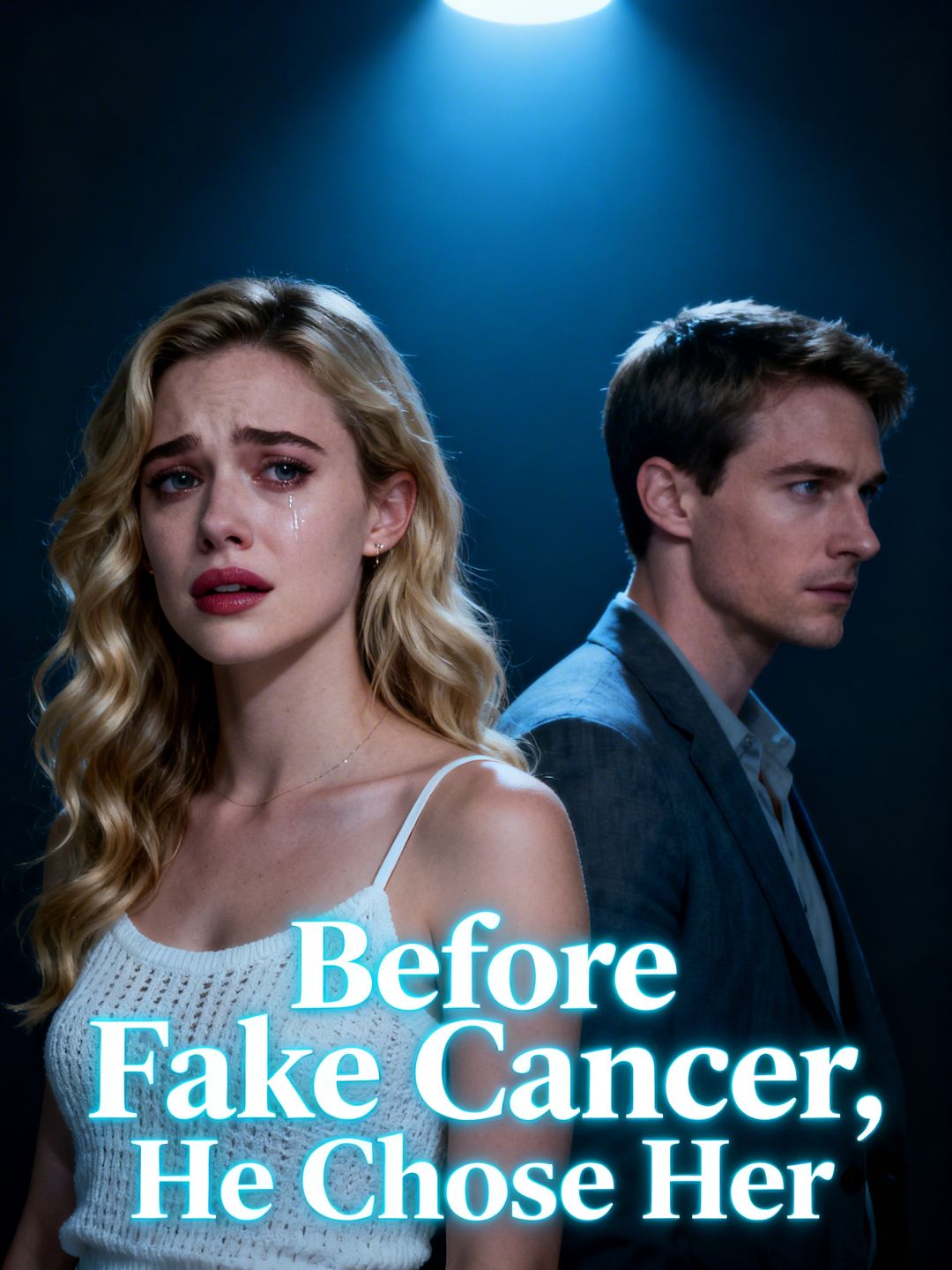
When I found out my husband Jones's terminal cancer diagnosis was a mistake, I breathed a sigh of relief. But when I got home to tell him the good news, he handed me divorce papers instead. "I've settled for you my whole life. Now that I only have three months left, I want to spend them with the person I truly love. Please grant me this final wish." I stared at the divorce agreement, stunned. What I didn't expect was what Jones said next: "Can't you even grant me this one last wish? I'm dying anyway—I'll leave with nothing. All the assets go to you!" All the assets go to me? Then of course I'll grant his wish! "Let's divorce. Please grant me this final wish." Jones handed me the divorce papers, his eyes calm, his tone solemn. I stood frozen, finally managing to ask: "The person you truly love? What do you mean?" Jones wore a white linen shirt and beige casual pants today. He didn't look over thirty at all—still the refined, scholarly university professor. He lowered his head. "My life has entered its final countdown. There's no need to hide it from you anymore." "Three years into our marriage, I met a girl. She was my student." "We often discussed literature together. We had so much common ground, our thoughts aligned. It was completely different from discussing groceries and bills with you. We had spiritual resonance." "I fell for her." "But I was already married. Out of responsibility to my family, and because she felt guilty toward you, we eventually separated." Jones's voice was calm yet tinged with longing. When he talked about that girl, the corners of his mouth even curved into a faint smile he probably didn't notice himself. "These years we've maintained a friendship, nothing crossing boundaries. When we occasionally met, we only discussed poetry and philosophy, life and meaning." He looked up, staring intently at me. "Do you know? Only when I'm with her do I feel truly alive, like a complete person. Not bound by mundane trivialities, not burdened by thoughts of producing offspring." "She's my muse, my soulmate. We're an accident and a regret constrained by worldly rules." I listened quietly to his heartfelt confession, my mouth twitching with an absurd smile. "What a beautifully reasoned speech." Jones froze, his ears instantly flushing red. As if deeply offended, he snapped angrily: "Vulgar! Not half as refined as her! Don't you know your mediocrity and ignorance are what I can't stand most? Marrying you was like casting pearls before swine!" I was speechless for a moment. My initial anger gradually subsided. "So what, should I apologize to you?" I stepped closer. "Professor Jones, does wrapping infidelity in artistic pretense turn it into an enviable love story?" Jones seemed to belatedly feel some embarrassment, but his gaze remained determined. "I'm definitely getting this divorce. At the end of my life, I don't want to leave with regrets." He pushed the divorce agreement toward me. I picked it up and flipped through it, my eyes skimming past "irreconcilable differences" in the reason column and landing on "Jones leaves with nothing" in the asset division section. Jones lifted his chin with apparent magnanimity. "These material possessions mean nothing to a dying man anyway. After all, I've wronged you. Consider it compensation." I let out a derisive laugh, thinking of the misdiagnosis notice in my pocket. The next second, I picked up a pen and quickly signed my name. Fine. Let him go pursue his soulmate and spiritual world. I'll suffer alone with all these vulgar properties, savings, and investment funds!
Jones probably didn't expect me to agree so readily. He stood there dazed, holding the divorce papers I'd signed. Taking advantage of his distraction, I'd already operated efficiently in the bedroom, packing all his clothes from the closet into two large suitcases. He seemed unable to process it. "Lester, are you really this eager to throw me out?" I gave him a baffled look and said irritably, "Just saving you from wasting time pursuing your soulmate." "All your clothes are here. Tomorrow I'll have movers send the books from your study. Give me an address—I'll send them cash on delivery. Don't forget to sign for them." Jones seemed to have an epiphany. "I understand now. Ever since you learned I had terminal cancer, you've been desperate to dump me, haven't you?" With a trace of condescending pity and disdain, he said as if deeply wronged: "This is why I've felt so suffocated being with you all these years. Our union was a mistake. You're vulgar, mercenary, only care about profit. All you ever talk about with me is money and trivialities. Being with you is a complete waste of life!" As he spoke, his expression became dreamy again. "But life shouldn't be like this. Douglas says life should be like appreciating a beautiful snowfall, should be romance and beauty, spring breezes and clear skies..." My mouth twitched. I really couldn't help interrupting him. "Are you done? This vulgar person can't stand listening to you adulterers and your flowery words. Take your things and get out. Now." Jones's gold-rimmed glasses reflected a cold light. The look he gave me was full of pity and contempt, as if I—the woman who'd shared his bed for years—was some filthy thing invading his sacred spiritual realm. His lips moved, about to retort, when a phone ring interrupted him. His mocking gaze instantly softened. After he answered, I vaguely heard a woman's voice. Probably his "Douglas." The woman said something on the phone—probably acting cute—and listening to her, Jones's face showed an indulgent tenderness I'd never seen before. Even his voice became gentle. He'd never spoken to me in that tone. I thought all married couples were like this—calm, stable, peaceful. Only now did I realize my marriage had been broken for a long time. Jones left. I looked at the empty room. Sunlight streamed in. The flowers on the balcony swayed gently in the breeze. Birds occasionally flew past the window. Everything was as usual. Nothing changed because of one person's departure. I thought I'd cry hysterically, have a breakdown. But I didn't. Enlightenment came so quickly. In just a few hours, my emotions went from wild joy to shock, from anger to calm, and now to a strange lightness. A man like that wasn't worth keeping. Now not only was I divorced, he'd voluntarily left with nothing. What was the difference between this and the saying "promotion, fortune, and husband's death"? Oh, I almost forgot. I touched the pocket containing Jones's misdiagnosis notice—my husband wouldn't die, he'd just smoothly roll out of my life in another way.
After calming down, my biggest worry was that Jones might suddenly have regrets. Life without him was incredibly liberating. I grew up in a very traditional family. Conservative parents gave me a conservative education. The first half of my life had been completely by-the-book. They taught me that at each age, you should do certain things. So after college, once my job was stable, I started a family with Jones, whom relatives had introduced. Back then, my parents were very satisfied with him. He was a literature professor at a local university—handsome, respectable job, decent income. My parents strongly promoted the marriage, and I thought Jones might be a good choice. I married him in a daze. Jones and I never even discussed "love." It seemed we'd just reached that life stage and mutually chose each other for marriage. I didn't even think this was a problem. After all, my parents were the same—introduced by others, formed a family, had me, lived their whole lives this way. I thought this was ordinary people's love. Just when I thought my life would continue peacefully this way, Jones was diagnosed with terminal cancer. In that moment I felt like the sky was falling. I thought it was reluctance born from loving my husband. But after the divorce, I realized it was just panic and helplessness facing a major life change. Learning Jones's terminal cancer was a misdiagnosis, I was overjoyed. That sense of life returning to normal washed over me completely. But now, my life had completely deviated from what I'd considered the "normal track," yet instead of panic, I felt liberated. I tallied up the assets Jones and I had accumulated over the years—enough for me to live comfortably. During the divorce cooling-off period, I learned to enjoy life. I took vacation days and traveled to several places I'd always longed to visit. Without being bound by the identity of "wife," I felt relaxed and free. Until during my travels, I happened to scroll past Jones's short video. And his "Douglas." The woman in the video looked under thirty, attractive, with long curly hair pulled back with a hair tie falling beside her face, shallow dimples when she smiled. Her name was Douglas. Whether the text, visuals, or filming style of Douglas's videos, everything was full of literary and aesthetic beauty. She didn't post frequently—starting with her alone sharing literary works, then a man appeared in frame, discussing their different literary insights together. Jones in the videos looked the same as before, wearing a soft knit sweater, his gold-rimmed glasses making him look refined and ascetic. Discussing love, Jones showed a thoughtful expression: "Love is something completely unreasonable. When it happens, no one can resist it. Even facing worldly constraints and shackles, it can't stop its inevitability." As he spoke, he looked tenderly at Douglas, his eyes full of unmistakable affection. Douglas lowered her head, loose hair falling by her temples, a blush coloring her cheeks. I opened the comments section. Everyone was praising their romantic love: "Oh my god, they're so good-looking, so easy on the eyes!" "When a literature professor falls in love, it's naturally more romantic." I looked at the comments, but didn't feel the slightest pain. Witnessing this moment of him being affectionate toward someone else, I truly confirmed—I didn't love him either. I smiled with relief and closed my phone. After the cooling-off period ended, Jones and I went to city hall to get our divorce certificate. Douglas followed beside him, looking at me with wariness, as if afraid I'd lose emotional control. But throughout the entire process I remained calm, even cheerfully so. Jones was still the same: "Our union was wrong from the start. Now everything's back on track. I wish you find your own happiness in the future." I smiled and waved the divorce certificate. "Thanks, I will. But definitely not through infidelity during marriage." With that, I left without looking back. After getting home, I confirmed all asset transfer procedures were complete, then mailed Jones's cancer misdiagnosis notice to his current address.
I thought after a peaceful divorce, we'd stay out of each other's way. I didn't expect Jones and Douglas's moral standards to be even lower than I'd imagined. A colleague sent me a link. I clicked on it—it was Douglas's short video account. She was livestreaming. In the livestream, Jones and Douglas wore matching couple outfits. One handsome and refined, one gentle and fresh—they actually looked quite compatible. But what they said was far from as decent as they looked. Jones spoke eloquently to the camera. "Yes, I am divorced. When I was young, I thought compatibility was love and rushed into marriage. But married life was extremely boring. My ex-wife and I repeated a monotonous routine. Every day was groceries and bills, discussing house loans, parents' retirement, when to try for a baby, workplace trivialities." "I wanted to discuss literature with her, talk about Camus, Shakespeare, Tagore, but she always listened blankly, unable to engage in meaningful conversation with me." "We lived a mediocre, dull life, like a dim, lusterless grain of sand. Until I met Douglas—my life was reborn." He looked tenderly at Douglas. Douglas gave a perfectly timed shy smile. The comments scrolled quickly. Many people were cheering for this divine romance. "Being with Douglas, we can discuss poetry, philosophy, life's meaning. Our thoughts align, our tastes and interests match. With her, I feel like I'm living life, not just existing." "After divorcing my ex-wife, I finally felt relieved. No more facing boring daily trivialities, no more facing a narrow-minded, vulgar wife, no more endless pressure from prolonged attempts to conceive..." Reading this, I froze. Jones and I had indeed tried to conceive for a long time without success. We went to the hospital once and discovered his sperm viability was too low, making natural conception very difficult. Following both parents' suggestions, we decided to do IVF. But it was his fertility problem. I was the one enduring the side effects of ovulation injections. I was the one who would bear the pain and fear of childbirth, and the permanent physical damage. What right did Jones—a man who was just along for the ride—have to sit here like a victim talking as if he'd suffered? During these years of marriage, I not only took care of him and gave him a warm home, but also helped care for his aging parents. In his eyes, it was nothing but "narrow-minded and vulgar." Anger surged up. I moved my finger and typed in the comment box: "A man who cheated during marriage—how dare you act like a victim? Does knowing some literature and art cover up the fact that you're both a cheating scumbag and homewrecker?" Among all the "perfect match," "talented scholar and beautiful lady," "made for each other" comments, my question stood out particularly. The comments seemed to pause for a moment, then scrolled even faster. Through the screen, I smiled and typed another line: "Jones, did you receive the follow-up diagnosis I mailed you?"
? Continue the story here ?? ? Download the "NovelMaster" app ? search for "378051", and watch the full series ✨! #NovelMaster